


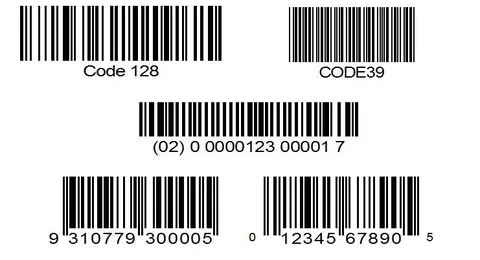
Barcode structure
GS1 International Platform on Barcodeshttps://www.gs1.org/
TOBB's website for information on barcodes in Turkeyhttp://gs1.tobb.org.tr/index.php
Detailed Information on Barcodeshttp://www.barcodeisland.com/syminfo.phtml#Background
Conversion of Numbers to Bars
The basic working principle is based on detecting the empty and filled intervals between the bars. Under the bars, there are only readable numbers for humans, and it is actually for people to control. When barcode writers convert numbers to bars, barcode readers convert bars to numbers according to the same industrial rules. Barcodes can also include letters and some signs depending on their type. 2D barcodes have a wider 'capacity' to include different information. EAN-13 and EAN-8 are commonly used in our country.
When we look at the barcodes, they seem to consist of complex lines, but each digit has its corresponding bar groups formed with the same logic. The numbers we see with our eyes, when converted to binary, will turn into 0s and 1s. For example, 7 is represented as 1011 in binary, which causes it to be displayed as line-space-line-line. That is, the space and thin line correspond to 0s and 1s. The 1s next to each other turn into thicker lines. To correctly encode barcodes of different sizes, there are alignment lines at the beginning and in the middle to indicate the height of the barcode. These are usually shown longer, so they may attract your attention.
Barcodes are used to distinguish similar products, in sales transactions, warehouse movements, to speed up processes and minimize user errors. They are also used in areas such as warehouse location codes, cargo packages, customer cards. There are different barcode types depending on the sector they are used in:
Numerical ones
EAN-8: 8-digit EAN structure
JAN: EAN structure used in Japan
UPC-A: 12-character structure used in the USA
UPC-E: 6-digit UPC
Alphanumeric ones
Code 128: International usage with detailed information
EAN 128: Mailing and product information
Code 39: US government and military usage
EAN13 Barcode Structure
The EAN13 barcode structure, which is the most commonly used in our country, consists of a total of 13 digits. If we look at the sections that we can symbolize as ÜÜÜFFFFSSSSSC,
ÜÜÜ 3-digit country code,
FFFF 4-digit manufacturer code,
SSSSS 5-digit product code,
C 1-digit 'check digit'.
Coding of In-Store Scale Products
In the EAN-13 standard, the codes 20-29 are reserved for in-company use. With these two digits, a total of 7 digits define the product. The scales then add the weight or quantity values to the next 5 digits, calculate the check digit, and produce a barcode compatible with the EAN-13 structure. When giving codes to products, it is common to separate the first two digits into product groups such as fruits, vegetables, and fish. Thus, the 7-digit codes consisting of the 20s code and 5-digit product codes are defined as barcodes in stock cards in back offices, which is the general practice in our country.
Calculation of the Check Digit
The control digit, which is equivalent to the English 'check digit', is an application that ensures readers are confident in the values they read. Starting from 12 digits, it calculates the digit according to the following formula and compares it with the 13th digit it normally reads.
Starting from the rightmost check digit to the end, we sum the values of the odd-numbered digits from the right and multiply by 3. Then, we add the even-numbered digits that we skipped in the first sum directly to this sum. The difference between the number we obtained and the closest number ending with 0 is the control digit. Readers also apply this formula to compare the digit they find with the 13th digit they read, ensuring the reading result. The control digit name comes from this.
For example, let's try to find the control digit X for 869123412345X. First, the value 869 on the left is used for the country code. We skip X and 5+3+1+3+1+6 = 19
3 X 19 = 57
4+2+4+2+9+8 = 29
57+29 = 86
(closest number ending with 0 = 90) - 86 = 4 Control Digit ('Check Digit')
EAN13 Country Codes
|
00-13: USA & Canada |
57: Denmark 590: Poland 594: Romania 599: Hungary |
779: Argentina 786: Ecuador |